

August 28, 2026
/
Managing Sweetener Side-Tastes Before They Hijack the Second Sip
“Zero sugar” is easy to put on the front of the can. The second sip is where the formula has to prove it.
The first sip can be gorgeous: bright berry aroma, crisp acid, sweetness right on target. Then the fruit disappears, sweetness keeps hanging around, and something bitter, metallic, cool, or vaguely licorice-like moves into the empty space.
That’s the part that gets mislabeled as a masking problem.
Often, it’s a timing problem. Sugar doesn’t just deliver sweetness intensity; it has a familiar rise and fall. Alternative sweeteners can trace very different curves, and some bring sensory baggage that outlives the flavor built around them. Studies comparing sweeteners over time have found meaningful differences in sweetness onset, duration, bitterness, and other side-tastes—even when samples are matched for overall sweetness.
The goal, then, isn’t simply to make a formula “sweet enough.” It’s to make sweetness arrive, behave, and leave at the right moments.
Bitter, metallic, cooling, licorice: same complaint, different problems
These descriptors get lumped together at the bench. They shouldn’t.
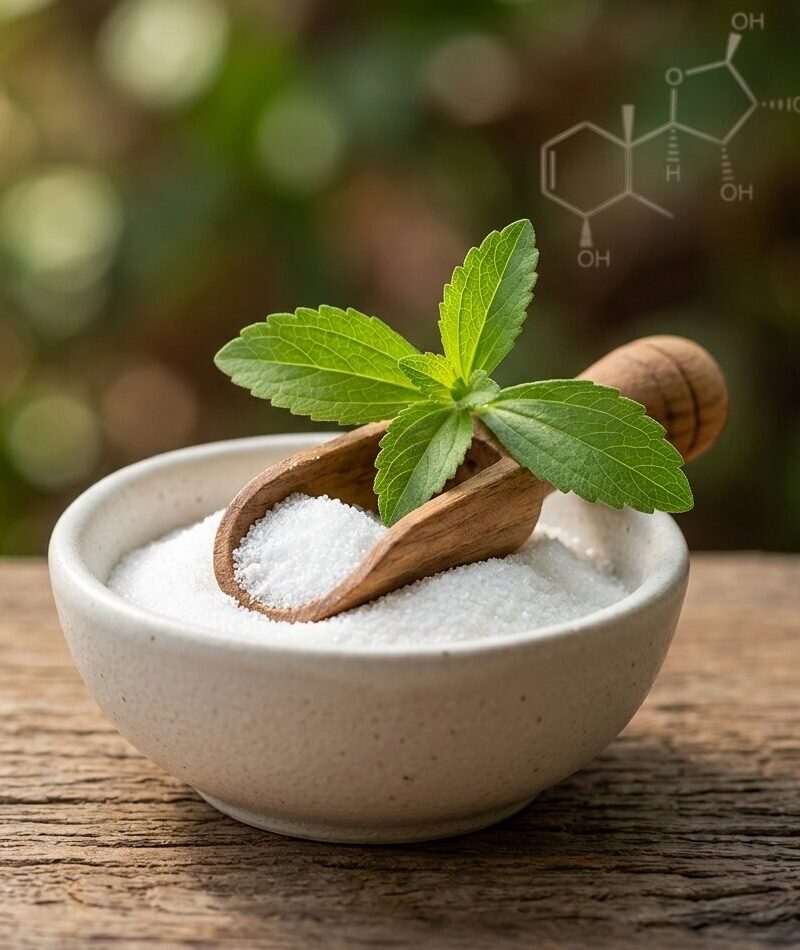
Bitterness
can be a genuine taste-receptor response. Steviol glycosides, for example, vary considerably in their bitter character; work comparing Reb A, D, and M found significantly different sweetness and bitterness profiles, with Reb A showing more bitterness than some newer glycosides. Bitter off-taste from steviol glycosides has also been linked to specific bitter receptors.
Metallic
is more slippery. It isn’t necessarily “bitterness with a funny name.” Research on artificial sweeteners and salts has connected metallic sensations with trigeminal receptor activation, reinforcing that the sensation can involve more than conventional sweet/bitter taste pathways.
Cooling
may be physical rather than flavor-driven. Crystalline erythritol absorbs heat as it dissolves, producing the familiar mouth-cooling effect. That can be fantastic in mint gum. In a caramel protein bite, it can feel like somebody opened a freezer door in the middle of dessert.
Then there’s the licorice/herbal linger associated with some steviol glycoside systems. Reviews of stevia sensory performance continue to identify bitter and licorice-like aftertastes as formulation limitations for certain glycosides.
Calling all four “off-notes” skips the useful part: figuring out which mechanism you’re actually fighting.
Your fruit flavor may be leaving before your sweetener does
Here’s where reduced-sugar formulas get sneaky.
Flavor isn’t perceived in separate aroma and taste lanes. Retronasal aroma—the volatile material reaching the nose from the mouth during eating and drinking—interacts with taste perception. Controlled sensory work has shown that sweetness can increase the perceived intensity of congruent retronasal aromas, and other studies have demonstrated important aroma–sweetness interactions.
So when sucrose leaves a formulation, the change isn’t necessarily “less sweet, add another sweetener.” The entire flavor relationship can move.
Imagine a zero-sugar peach beverage. The peach top notes hit fast and decay. The high-intensity sweetener peaks later and hangs around. Now the consumer is left with sweetness after the peach has packed up and gone home.
That gap is where “diet” starts to announce itself.
Turning up peach flavor may make the first five seconds louder while doing nothing useful at second 25. Worse, an aggressive fruit top note sitting over a bitter or metallic base can make the whole system read more chemical.
Fix the floor before you repaint the ceiling.
Build sweetness as a curve, not a number
This is why blends are so useful. Different sweeteners can contribute different onset, peak, linger, and side-taste characteristics; research on low-calorie sweetener blends has specifically investigated combinations that produce sweetness synergy and sensory profiles closer to sucrose.
The useful question isn’t “Which sweetener is best?”
It’s: Which sweetener system behaves correctly in this product?
A sharp citrus CSD, creamy RTD coffee, hydration beverage, and high-protein shake don’t need the same sweetness architecture. Acid, minerals, protein, flavor character, mouthfeel, temperature, carbonation, and repeated sipping can all change what gets noticed.
In one multiple-sip study, sucralose produced a profile relatively similar to sucrose in passion fruit juice, while stevia formulations showed greater dominance of bitterness and off-flavor. That result isn’t permission to crown one universal winner. It’s a reminder to judge sweeteners in the matrix—and across multiple sips.
Flavor & Format Playbook (7 Concept Starters)
When the finish goes sideways, work upstream.
Start with the base.
Lock pH, titratable acidity, mineral contribution, solids, and mouthfeel before fine-tuning the flavor system. Otherwise you’re masking a moving target.
Then attack the actual side-taste.
Bitter control belongs before fruit amplification. Cooling may require rethinking the polyol system or physical state rather than throwing vanilla at it. A licorice-like tail may call for a different steviol glycoside composition or blend.
Now rebuild character.
Use aroma notes that support the desired sweetness curve, not simply louder top notes. Vanilla, berry, caramel, and other congruent aromas can influence sweetness perception, but that cross-modal help needs to arrive when the formula needs it.
Finally, smooth the finish.
The last few seconds matter disproportionately in repeat-sip products. If sweetness and bitterness are still arguing after the fruit is gone, the formula isn’t finished.
Masking has a role. It just shouldn’t be the first responder to every sensory emergency.
Measure what happens after “tastes good”
A static sweetness score can miss the entire crime scene.
Run time-intensity on sweetness plus the relevant negatives—bitter, metallic, cooling—long enough to capture the finish. For many beverages, a 0–180 second window gives a much better picture than a single immediate rating. Temporal methods have repeatedly shown that sweeteners differ not just in maximum sweetness, but in onset, duration, and lingering side-tastes.
Then run a repeat-sip protocol. A beverage isn’t consumed one carefully measured spoonful at a time. Side-tastes can become more obvious—or simply more annoying—after sip three.
Add a CATA question for descriptors such as “diet,” “chemical,” “metallic,” “herbal/licorice,” and “cooling.” If instrumentation is available, compare aroma release over time against the sensory curve. And don’t ignore shelf life: degradation of Reb A in food systems has been studied specifically for its potential contribution to flavor instability during storage.
A day-one prototype can have impeccable manners. Month six may be a different roommate.

The second sip is the real specification
Sugar reduction gets treated like a substitution exercise far too often: remove grams of sucrose, restore sweetness, move on.
The better brief is temporal.
When does sweetness appear? What else appears with it? When does the character aroma disappear? What owns the finish? And, most importantly, does the consumer want another sip?
Design that curve correctly and “zero sugar” stops tasting like a technical achievement the consumer is expected to forgive. It just tastes like the product was supposed to taste.
That’s a much higher bar. It’s also the one worth formulating for.
R&D Takeaways
- Design sweetness as a curve, not a single intensity target. Track onset, peak, decay, and linger.
- Fix bitter or metallic character before turning up fruit top notes. More aroma can make a broken base louder, not better.
- Blend for timing. Look for fast, convincing sweetness onset without letting bitterness, licorice character, cooling, or sweetness own the finish.
What to Measure
- TI/TDS for sweet, bitter, metallic, cooling, and relevant aroma attributes over roughly 0–180 seconds
- Repeat-sip sensory plus “diet signature” CATA
- Aroma/headspace behavior over time where instrumentation permits
- pH, titratable acidity, mineral load, and shelf-life sensory—not just day-one performance
Insights & Trends
Premium, Complex… or Medicinal?
September 28, 2026
The Scoville Scale Is Losing the Plot
September 14, 2026

Why the Second Sip Gives Your Sweetener Away
August 28, 2026
When “Naturally Sweet” Gets Complicated
August 11, 2026
The “Protein Problem”
July 29, 2026
Lemon-Lime Lost Its Monopoly
July 14, 2026

Coffee’s Next Frontier
June 22, 2026
Maximalism, Refined: Why Bigger Flavor Is Getting Smarter
June 12, 2026
Spice Without Pain
May 29, 2026
Botanicals Take the Lead
May 14, 2026
Color Talks Before Flavor Does
April 28, 2026

From “Asian-Inspired” to Region-True
April 13, 2026

Strawberry’s Not Moody—Your Formula Is
March 31, 2026

Dessert Déjà Vu, Upgraded
March 12, 2026

Cravings, Rewired: The Science of Shifting Taste
February 26, 2026
Swicy, but Make It Fruit
February 12, 2026

Nostalgia Flavors
January 28, 2026
Stack Attack
January 13, 2026
The Aftertaste Ambush
January 1, 2026
Function in Disguise
December 12, 2025
View All Blog Posts